
Concrete Roof Slab Waterproofing System
Concrete Roof Slab Waterproofing System
A concrete roof slab is not waterproof on its own. Concrete is porous, it cracks as it cures and moves, and flat roofs hold water at outlets and parapets. EcoSeal waterproofs new and existing slabs with SealPro’s seamless system: a penetrating primer, a reinforcement membrane that absorbs movement, and three to five coats of UV-stable HydroSeal HF. Older slabs with a failed membrane get the fibreglass-mesh ArmTec HyperFlex system. As SealPro’s approved applicator, we supply the product and apply it ourselves, with a written guarantee.
Slab waterproofing in short
| Question | Answer |
|---|---|
| Does a new slab need waterproofing? | Yes. Concrete is porous and cracks as it cures. |
| Best system | Penetrar primer + StretchSeal reinforcement + 3–5 coats HydroSeal HF (ArmTec HyperFlex for failed membranes) |
| First layer | Penetrating primer (Penetrar) after cleaning and repairs |
| Cure time | 4 hours before light rain, 48 hours before heavy rain or a flood test |
| Time on site | 2–5 working days for most homes |
| Over old torch-on? | Yes, if it is still bonded (UltraBond WP primer) |
The SealPro roof slab waterproofing system, layer by layer
1 · Clean, repair and prepare the slab
Loose and flaking material removed, cracks opened and filled, outlets cleared and falls checked so water drains instead of ponding.
2 · Prime with Penetrar

Penetrar soaks into the porous concrete, binds dust and loose particles, strengthens the surface and gives the membrane something to grip.
3 · Reinforcement membrane

StretchSeal reinforcement is embedded with Repello. On new slabs it covers the whole surface. On existing slabs it goes into every crack, corner, upstand and outlet. It absorbs movement and hairline cracking.
4–6 · Three to five coats of HydroSeal HF

HydroSeal HF is applied by block brush, alternating direction each coat and letting each coat touch-dry before the next. The result is one seamless, UV-stable waterproof skin.
7 · Cure and test
At least 4 hours before light rain, and 48 hours before heavy rain or a flood test. Full cure and final strength follow over the next days.

Signs your slab needs attention
- Damp patches or brown stains on ceilings below a slab
- Efflorescence (white salts) or bubbling paint on walls under a parapet
- Blistering, lifting or split torch-on waterproofing
- Ponding water that stands for days after rain
- Cracks across the slab or along parapet junctions
- Blocked or rusted outlets and downpipes
Recent roof slab waterproofing projects
We have waterproofed more than 60 roof slabs across Pretoria, Centurion and Johannesburg. A few recent jobs are below, and more are on our projects page.
Roof slab waterproofing in Moreleta Park, Pretoria


Problem: A flat slab between two tiled pitches. The old membrane had delaminated and worn through to bare concrete, and the outlets sat too high, so water pooled.
What we did: Renewed from the substrate up with the reinforced ArmTec system, joints reinforced and drainage corrected. See the full project →
Roof slab waterproofing in Woodhill Golf Estate, Pretoria


Problem: Slabs over two garages, a bedroom and a poolroom. The membrane had lifted and cracked, and the drain outlet surrounds had crumbled.
What we did: Outlet surrounds rebuilt, every slab primed and covered with one continuous, mesh-reinforced membrane under a written guarantee. See the full project →
Roof slab waterproofing in Steyn City, Johannesburg
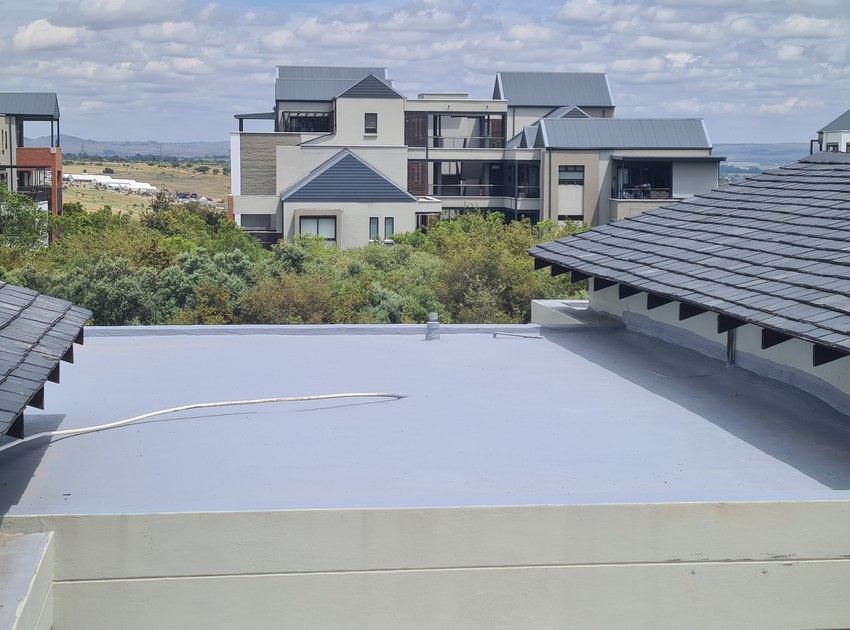
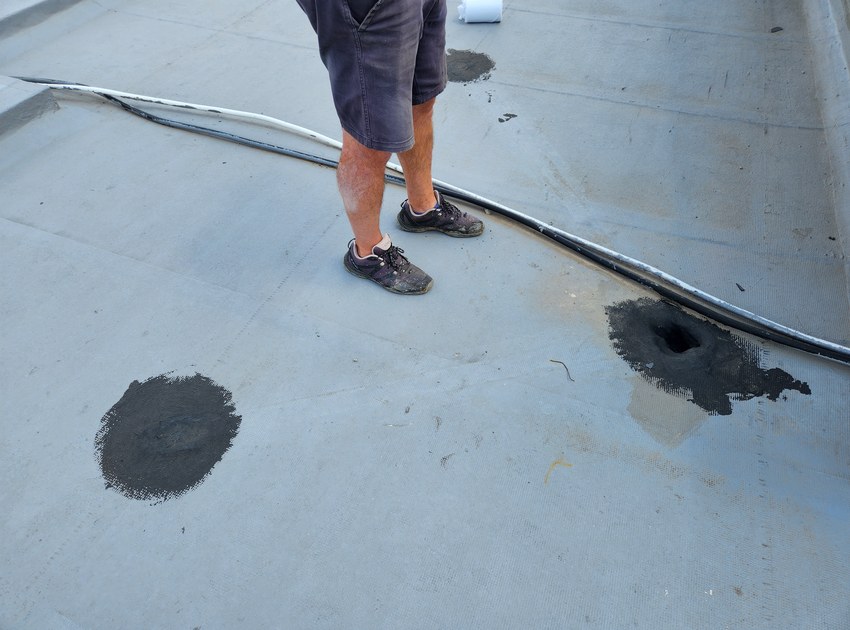
Problem: A large slab above a bedroom and bathroom. A badly placed outlet collected standing water, and a slow leak showed only in heavy storms.
What we did: Drainage repositioned to two new outer-wall outlets, then the slab sealed with the ArmTec HyperFlex system. See the full project →
Roof slab waterproofing in Olympus, Pretoria (commercial)


Problem: A commercial flat roof with delaminated waterproofing, open joint cracks, and membrane separating at the parapets and pipe penetrations.
What we did: Old layer stripped back, parapet joints and penetrations reinforced, and a continuous membrane and topcoat applied. See the full project →
Does a new concrete roof slab need waterproofing?
Yes. Concrete is porous, and every slab develops shrinkage and movement cracks as it cures and goes through Highveld temperature swings. Good falls and outlets help water run off, but they do not make the slab waterproof. Waterproof a new slab once it has cured, before the first rainy season, and cover the whole surface with a reinforcement membrane so hairline cracks cannot telegraph through.
Why flat roofs and slabs leak
- Ponding: poor falls or outlets set too high leave water standing for days, and it eventually finds a way in.
- Outlets and penetrations: the junction around drains, pipes and cables is the most common entry point we find.
- Parapet and upstand junctions: the wall and slab move differently, and an unreinforced coating splits along the joint.
- Movement cracks: daily expansion and contraction opens cracks that a rigid or unreinforced coating cannot bridge.
- Aged membranes: UV breaks down old coatings and torch-on until they blister, delaminate or crack.
Water also travels under the old membrane, so the damp patch on your ceiling is often metres from where it gets in. We trace the entry point before quoting.
New slab, existing slab or lightweight slab?
| Situation | What we install |
|---|---|
| New concrete roof slab | Full system: Penetrar primer, StretchSeal reinforcement over the entire slab, 3–5 coats HydroSeal HF |
| Existing slab, coating still sound | Maintenance: clean, repair cracks and details, and renew with HydroSeal HF |
| Existing slab with failed, cracked or delaminated membrane | Strip back, then the fibreglass-mesh reinforced ArmTec HyperFlex system |
| Old torch-on that is still bonded | UltraBond WP bonding primer and a reinforced system over it, with no stripping needed |
| Lightweight concrete slab | The same water-based HydroSeal HF system. It is light, flexible and suits lightweight decks. |
Liquid membrane or torch-on?
Torch-on bitumen works, but on sunny Highveld roofs its laps, edges and upstands are where it fails first, and it is hard to detail around outlets and penetrations. A liquid-applied acrylic system like HydroSeal HF is seamless, has no laps to open, follows every corner and outlet, is UV-stable, and is applied cold with no open flame on your roof. It can also renew over sound old torch-on instead of stripping it.
What affects the cost of slab waterproofing
- Slab area and number of outlets, upstands and parapets
- Whether old torch-on can be renewed over or must be stripped
- Crack repair and screed work needed for falls
- Access and whether furniture, planters or tiles must be moved
- Balcony or walk-on areas versus non-trafficked roofs
We measure on site and give a written, itemised quote listing the preparation, the reinforcement and the number of coats. That is the only way to compare quotes fairly.
Maintaining a waterproofed slab
Keep outlets and gutters clear, especially before the rainy season. Don’t let water pond behind planters or equipment. Have installers of solar, aerials or air-conditioning seal any new penetration properly. A renewal coat of HydroSeal HF every few years, before the membrane is worn through, costs far less than a full strip-and-redo.
Related: flat roof waterproofing · ArmTec HyperFlex system · first-floor concrete slabs · tile roof waterproofing system
Roof slab waterproofing FAQs
How do you waterproof a concrete slab roof?
Clean and repair the slab, prime it with a penetrating primer (Penetrar), embed a reinforcement membrane (StretchSeal) over cracks and details or the whole slab, then apply three to five coats of a UV-stable waterproofing membrane such as HydroSeal HF. Allow 48 hours before heavy rain or a flood test.
What is the best waterproofing for a concrete roof slab?
A reinforced, liquid-applied system that penetrates and binds the concrete, then seals it with a seamless, flexible and UV-resistant membrane. On existing slabs with failed coatings, a fibreglass-mesh system like SealPro ArmTec HyperFlex gives the most crack resistance.
What is the first layer when waterproofing a concrete roof slab?
After cleaning and repairs, the first layer is a penetrating primer. SealPro Penetrar binds loose particles, strengthens the surface and improves adhesion for the reinforcement and waterproofing layers.
Does a new concrete roof need to be waterproofed?
Yes. Concrete is porous and develops shrinkage and movement cracks. Waterproof a new slab once it has cured, with a reinforcement membrane over the whole surface.
How long does it take to waterproof a roof slab?
Most residential slabs take 2 to 5 working days, depending on size, repairs and weather. The system needs about 4 hours before light rain and 48 hours before heavy rain.
Do you have to remove old torch-on?
Not always. If it is still well bonded, we prime it with UltraBond WP and apply the reinforced system over it, which is cheaper and less disruptive than stripping.
Why does my ceiling leak far from the visible crack?
Water travels along the slab or under the old membrane before it drips through, so we diagnose the entry point before quoting.
Is the waterproofing guaranteed?
Yes. As SealPro's approved applicator, EcoSeal supplies and applies the system to manufacturer specification and issues a written guarantee.
Flat roof & slab waterproofing by area
Pretoria EastMoreleta ParkWaterkloofLynnwoodFaerie GlenGarsfonteinSilver LakesWoodhill EstateMooikloofEquestria & Die WilgersThe Hills, The Wilds & LombardyCenturionIrene & SouthdownsMidstream EstateCornwall Hill EstateCopperleaf EstateEldoraigneBlue Valley Golf EstateBlair Atholl Golf & Equestrian EstateMidrandWaterfall EstateKyalamiBlue HillsBeaulieu, Glen Austin & The PolofieldsJohannesburg NorthDainfernFourways & LonehillBryanstonSandhurst, Illovo & MorningsideParkhurst & ParkviewAll service areas